


Most companies order 3D renderings of a residential development to help sell the project more effectively.
They want to showcase the architecture, the atmosphere of the place, the quality of the design, and the future lifestyle of its residents.
In this case, the goal was completely different.
Here, the 3D renderings of a premium residential development were not meant to simply look good.
They were meant to show the scale of the problem.
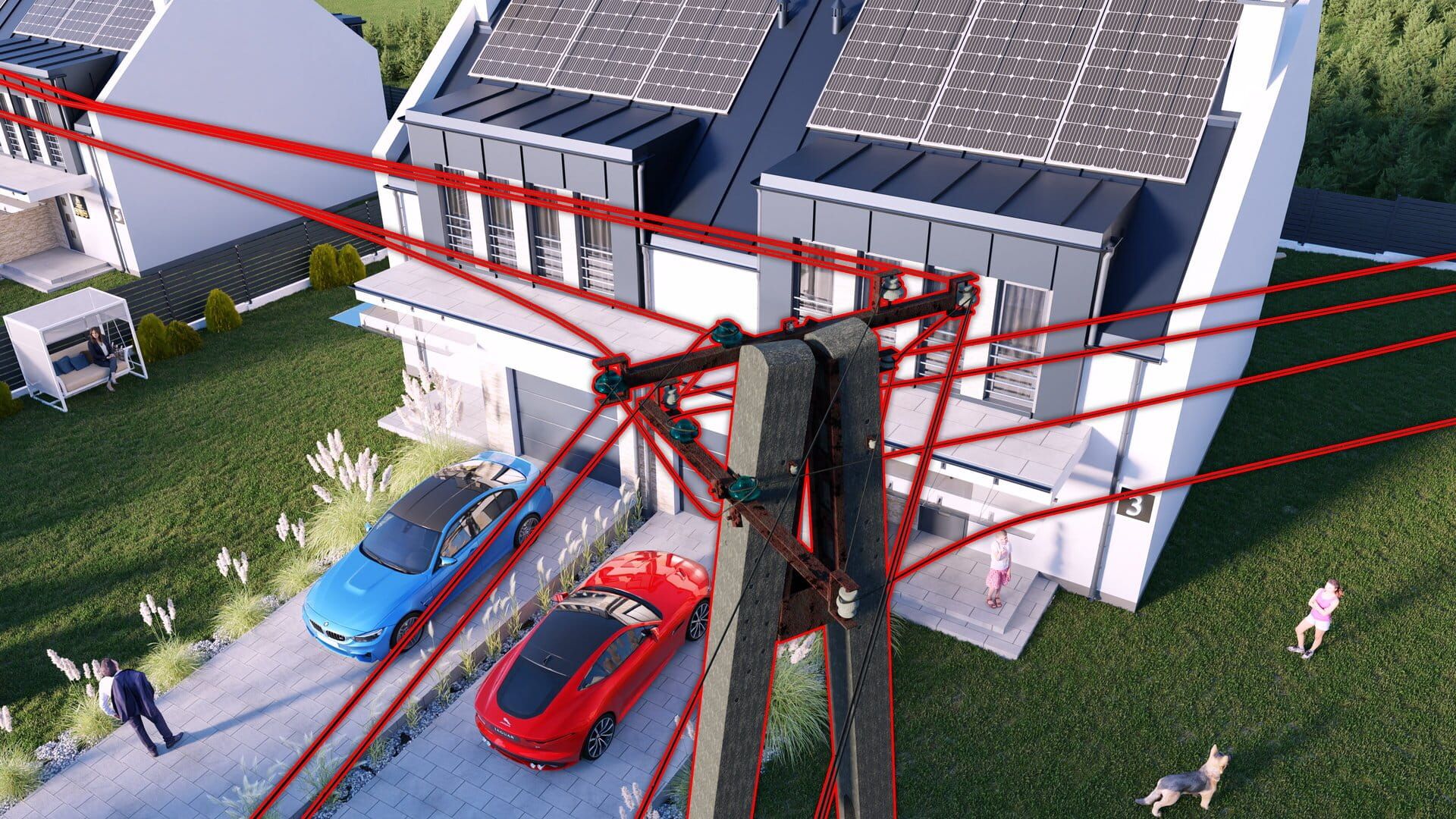
The client needed material that would clearly, powerfully, and simply show the difference between the full potential of the development and the actual limitations caused by the route of the power lines. That is why the project was designed from the start around two versions of the same development: a marketing version with the full 10 home layout, and a technical version limited to 7 homes, with the lines, poles, protection zones, and key distances clearly marked.
And that is exactly why this case is so interesting.
Because it shows that strong 3D renderings for real estate developers can do much more than support marketing.
They can also organize an argument, strengthen the message, and help show a loss that cannot be explained as clearly with text alone.
When do residential 3D renderings need to do more than sell?
Normally, a 3D rendering of a residential development is meant to build interest.
It is meant to attract attention.
It is meant to increase the perceived value of the project.
It is meant to help the buyer imagine the completed development before construction begins or before it is finished.
Here, however, aesthetics alone were not enough.
What was needed was material that could show two versions of the same development.
The first version was the full, attractive premium concept.
The second version was the real situation after taking into account the limitations imposed by the route of the power lines.
That is exactly why version A was meant to be a clean, photorealistic marketing vision with 10 homes, while version B was meant to be a technical and illustrative 7 home version, prepared in a way that would allow it to work as an attachment to a court filing, an appraiser’s opinion, and a case against ENEA.
This is no longer a standard render for a sales brochure.
This is a 3D rendering meant to do much more.
From 10 homes to 7. How an image shows the scale of the loss faster than a description
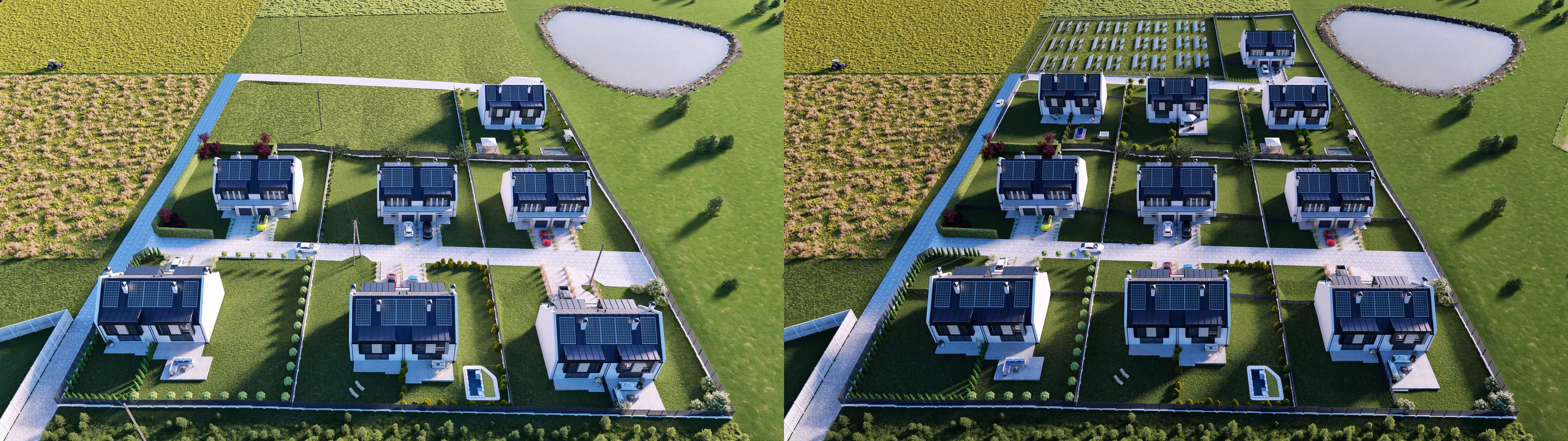
One of the strongest parts of this case was the difference between the two versions.
In the original concept, the development was supposed to include 10 homes.
In the real version, only 7 remained.
That meant the loss of 3 buildable lots and a clear reduction in the project’s potential. The client wanted the material to clearly communicate the loss of approximately 450 to 600 square meters of usable floor area, as well as the reduction in the number of buildings from 10 to 7.
And this is exactly where an image beats a written description.
Because you can write that the project was limited.
You can add that part of the development had to be removed because of the power lines.
But only a side by side comparison of two comparable renderings shows how significant that difference really is.
The developer, the attorney, the appraiser, or anyone else reviewing the material does not need to spend much time analyzing it.
They see it immediately.
Two versions of the same development. The same frame. The same perspective. A stronger effect
In a project like this, it is not enough to create two separate images.
You need to build a comparison that leaves no room for confusion.
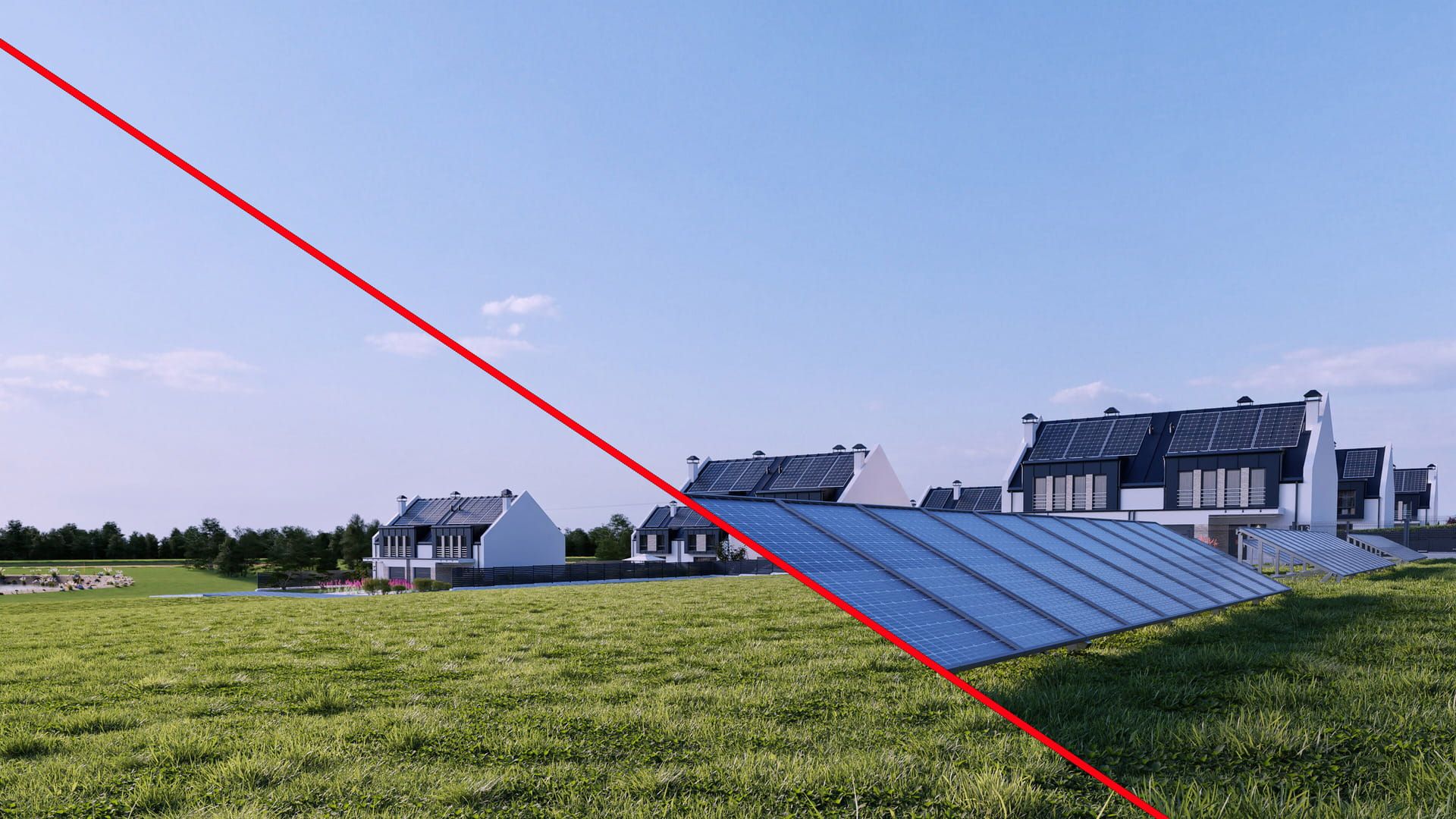
That is why one of the key assumptions was to keep the same camera angles and the same perspective in both versions. The material had to be prepared so that the 10 home version and the 7 home version could be compared directly.
This is a detail that makes a huge difference.
Because when both frames are consistent, you stop looking at two separate images.
You start looking at the difference.
And that was the point of this project from the very beginning.
Marketing rendering and technical rendering. Two functions, one goal
In this case, we were not creating one universal piece of material.
We were creating a system of materials that had to work in different situations.
The marketing part was meant to present the premium development in its best light, with refined landscaping, greenery, roads, architectural detail, and subtle premium and renewable energy elements. The concept also included features such as a micro solar farm, a premium residential standard, and accents suggesting smart home features and modernity.
The technical part, in contrast, had to be clear, specific, and formally useful.
It had to include the route of the power lines, the marking of poles, protection zones, excluded areas, key dimensions, a legend, and switchable layers. What is more, the project brief explicitly stated that the technical infographic had to be readable and useful for an appraiser, an attorney, court filings, and a case against ENEA.
That shows something very important.
Strong residential 3D renderings do not end with aesthetics.
They are meant to solve a specific business or communication problem.
The material had to work on both emotion and argument
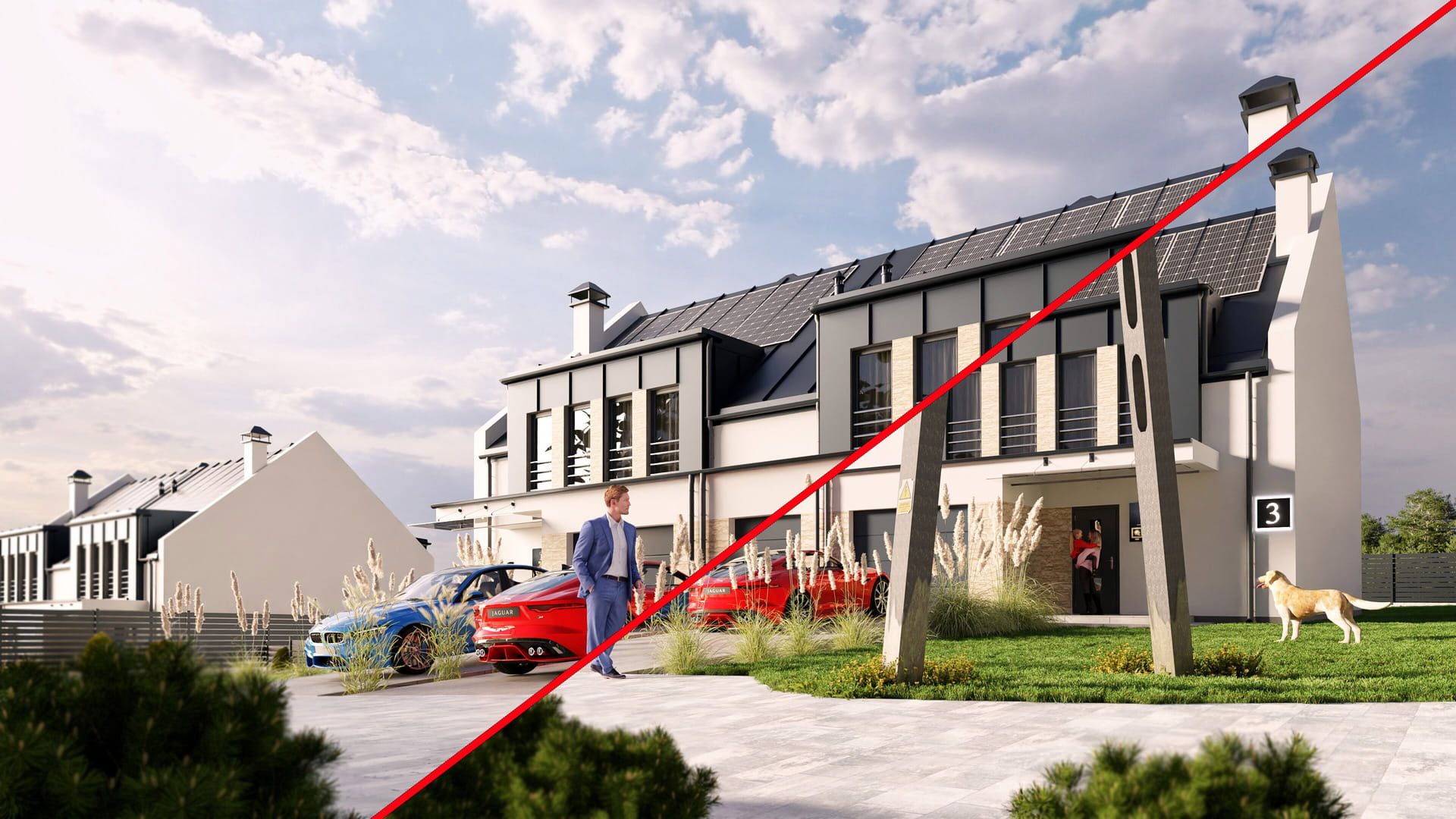
This is one of the strongest aspects of the entire project.
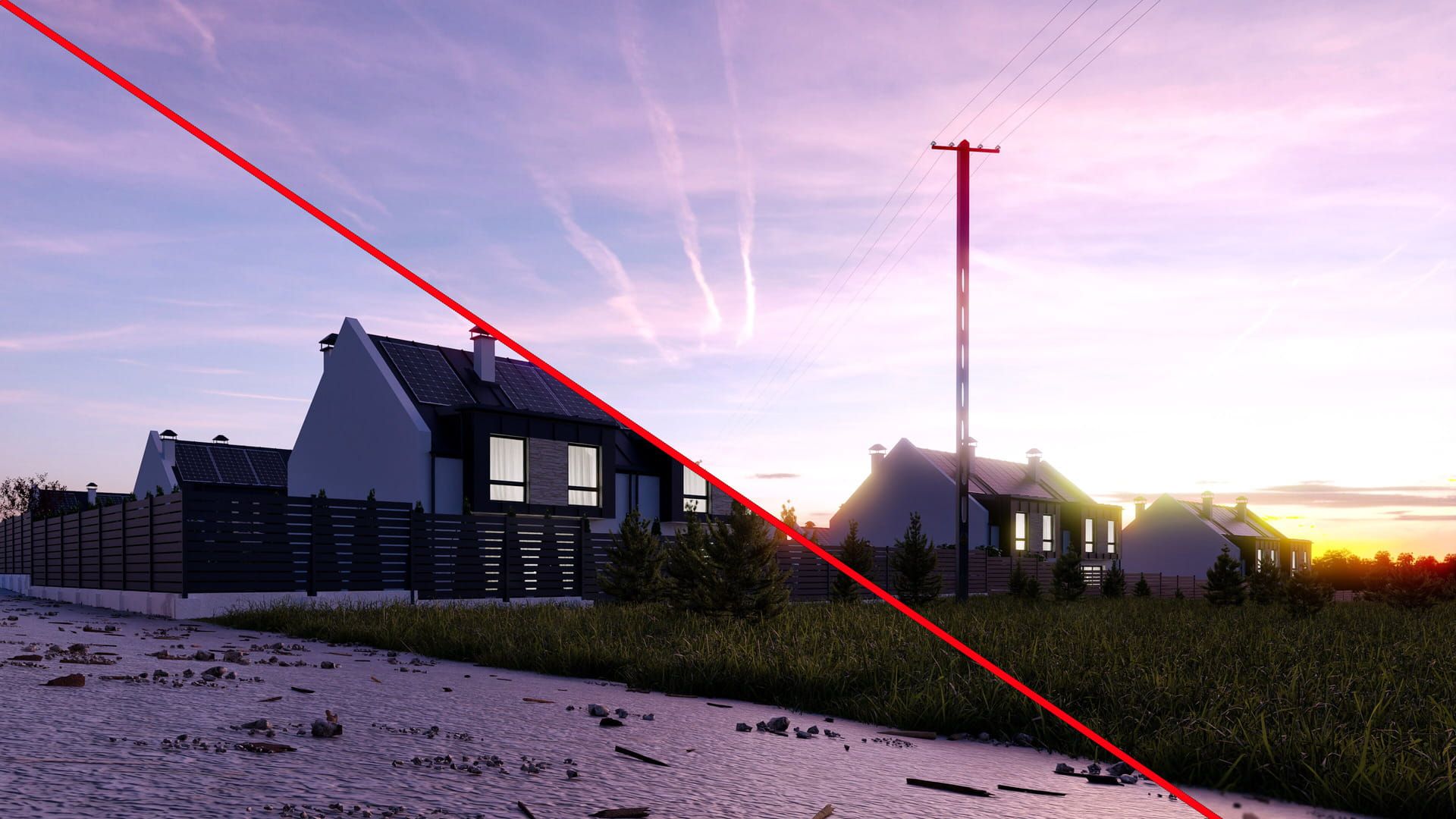
The brief for the production team clearly stated that the aerial views and infographic were meant to build a factual argument, while the ground level renderings were meant to build an emotional argument. On top of that, the human perspective views were meant to show everyday life in the development and the clear impact of the power lines on how the place would be perceived.
That is a very strong approach.
Because the technical board alone helps organize the facts.
But it is the human level visuals that show how the presence of infrastructure affects the perception of the space, the comfort, and the overall quality of the development.
And that is exactly why this type of material works more effectively than a plan, a map, or a written description alone.
Here, it was not only image quality that mattered, but the strength of the message
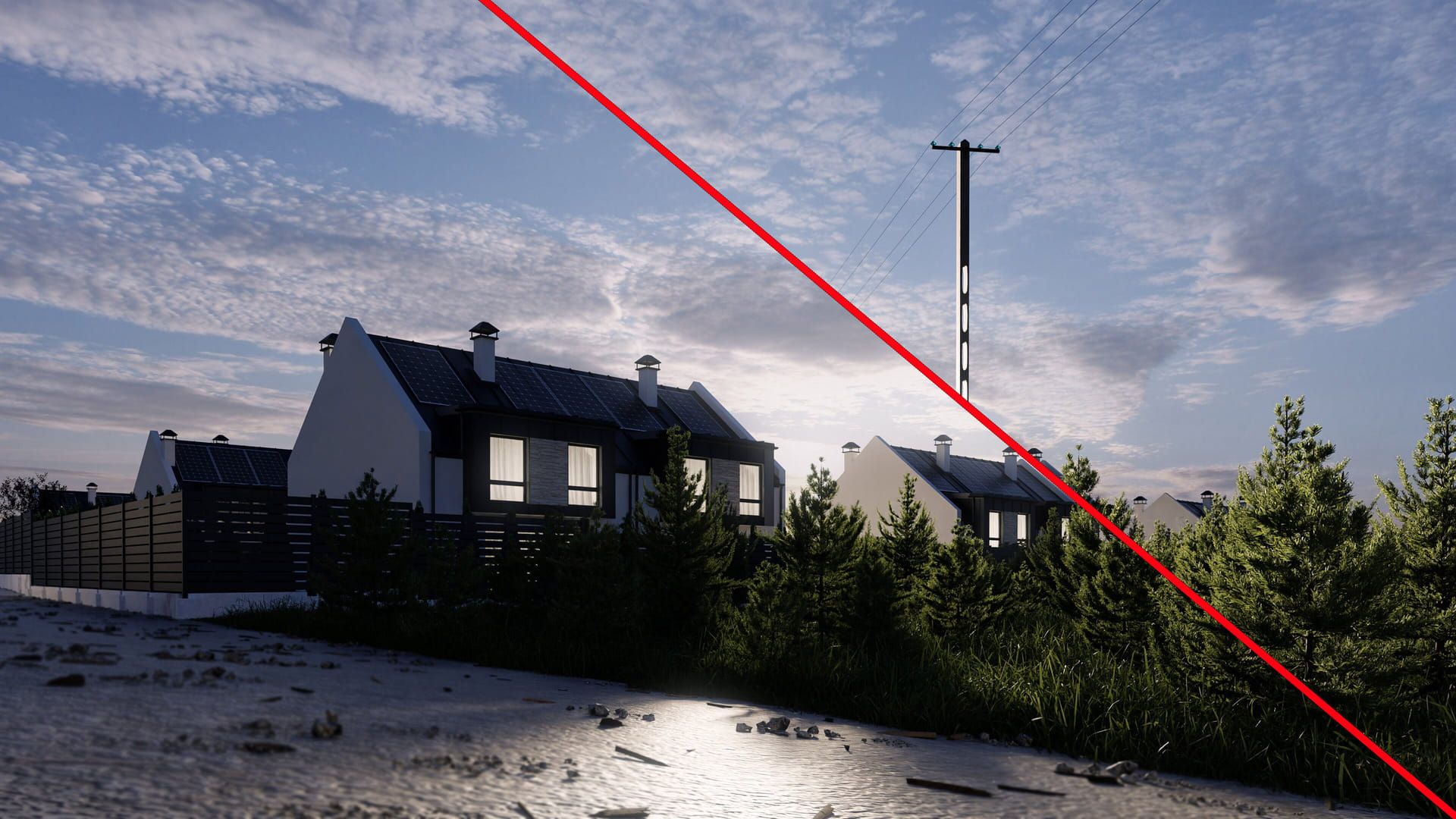
At one point, the client asked for version B to become even stronger as an evidentiary tool.
The excluded lots were to be marked with a darker, more aggressive red.
The protection zones were to be made thicker.
The labels were to be larger.
And a simple box in the corner was to include the most important information about the loss of 3 lots, the reduction in the number of buildings from 10 to 7, and the loss of approximately 450 to 600 square meters of usable floor area.
This is a very interesting moment.
Because it shows that in projects like this, the goal is not for the material to be visually appealing alone.
It has to be understandable within a few seconds.
It has to lead the viewer to one conclusion.
It has to show the scale of the limitation without unnecessary explanation.
What does this case say about 3D renderings for real estate developers?
This project shows very clearly that 3D renderings for developers can work on several levels at the same time.
They can sell the development.
They can build the project’s prestige.
They can show the quality of the architecture and the premium standard.
But they can also explain a problem, organize a difficult issue, and show the real difference between the original plan and reality.
That is why it is a mistake to treat renderings only as a nice addition to an offer.
A well prepared 3D rendering of a residential development can become a communication tool that clearly shows what is not visible at first glance.
Why is it worth trusting this kind of project to a team that understands more than aesthetics?
The ability to create a beautiful render is not enough.
In more demanding projects, you need to understand why the material is being created.
You need to know how to connect visual quality with precision of message.
You need to know when an image should build emotion and when it should build an argument.
In this case, that was exactly what mattered most.
The final package included aerial views, ground level renderings, and a technical infographic. The entire set had to maintain a premium standard while also being useful in formal and procedural contexts. The final deliverables included two aerial views, eight ground level renderings, and one technical infographic, all prepared in 4K and in multiple usage variants.
This is not a random set of graphics.
It is a carefully planned package of material designed to work across different touchpoints of the project.
Summary
Not every 3D rendering of a premium residential development ends up on a website or in an ad.
Sometimes it goes further.
Into conversations with partners.
Into argumentation.
Into formal materials.
Into court.
This case clearly shows that residential 3D renderings can do much more than simply look good. They can clearly show the difference between the full potential of a development and what actually remains after real world limitations are taken into account. And when the material is thoughtfully prepared, it starts working with real force.
If you are looking for a company that creates residential 3D renderings that are not only impressive, but also strategically designed, let’s talk.
At REND.PRO, we design materials that are meant to look premium, build the value of a development, and support a real business objective.


